
Florida Property Tax Reform 2026: What Winter Park Homeowners Need to Know Before the November Vote
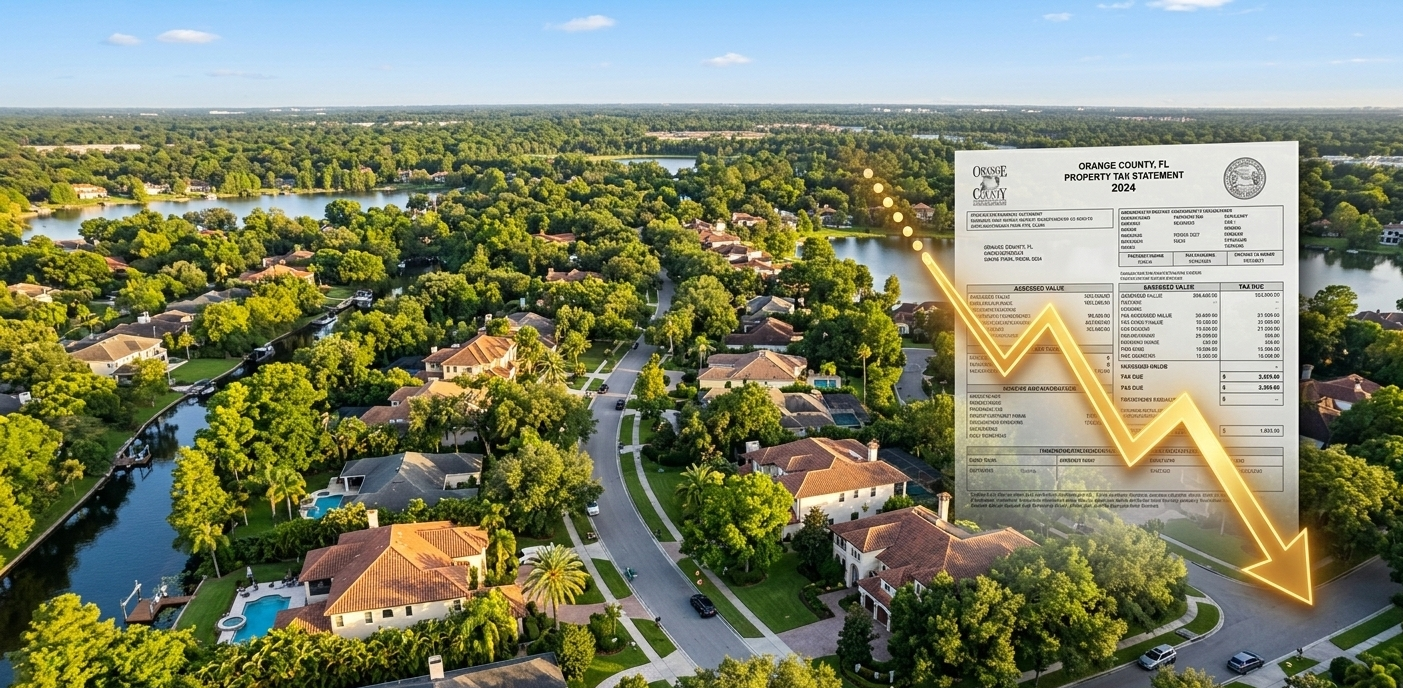
As of March 2026, the Florida House has advanced HJR 203, a historic proposal that would phase out all non-school property taxes for primary homestead residences over 10 years. If passed by the Senate and approved by 60% of voters in November 2026, the phase-out begins January 1, 2027 — with the exemption growing by $100,000 annually until full elimination by 2037. For most Winter Park homeowners, this means a 50% to 60% reduction in their total property tax bill. These benefits apply only to primary residents with a homestead exemption. Investment properties and second homes remain under the current tax structure.
The 2026 Shift: Is Florida Really Eliminating Property Taxes?
For decades, Florida homeowners have accepted property taxes as a fixed cost of ownership — an annual bill that climbs alongside home values regardless of income or financial circumstance. That assumption is now formally under challenge in Tallahassee.
The Florida Legislature is debating a slate of constitutional amendments aimed at the November 2026 ballot. The centerpiece is House Joint Resolution 203 (HJR 203), sponsored by Representative Miller. According to the Florida House of Representatives, HJR 203 proposes a constitutional amendment that increases the homestead exemption for all non-school ad valorem taxes by $100,000 per year for ten years — beginning in 2027 — making homestead properties fully exempt from non-school property taxes by 2037.
The bill passed the House floor on February 19, 2026 with an 80–30 vote. As of publication, it sits in the Florida Senate Appropriations Committee with no hearing yet scheduled, and the regular session ends March 13, 2026.
“Florida’s success has been built on smart fiscal policy, economic opportunity and a very clear identity. Major tax reform should strengthen those pillars, not complicate them.”
— Peggy Olin, President & CEO, OneWorld Properties, via Fox BusinessA key political dynamic to watch: Governor DeSantis, who has expressed broad support for homestead tax relief, posted on February 19 that “it’s better to do it right than do it quick” — signaling a preference for a more deliberate approach. The Senate has not advanced a companion bill. The exact form any ballot measure takes — if it makes the ballot at all — will be decided in the final days of the March 13 session.
Winter Park by the Numbers: What’s Actually at Stake
To understand what this reform means for your household budget, you need to understand how your Orange County property tax bill is constructed. Your annual bill is not one charge — it is a sum of separate levies from different taxing authorities, each with its own millage rate.
The City of Winter Park carries its own millage rate on top of the Orange County base rate of approximately 4.4 mills. When you combine the city, county, and special district levies, the non-school portion of a Winter Park homeowner’s bill typically represents around 55–56% of the total.
Estimated Annual Savings — $800K Home in 32789 / 32792
Based on the non-school millage rate for City of Winter Park homestead properties. Exact savings depend on your assessed value, current exemptions, and specific millage district. Savings grow each year as the $100,000 annual exemption increase phases in through 2037.
For context: a Winter Park home assessed at $500,000 — after the current $50,722 homestead exemption — paying a combined non-school millage rate of approximately 10 mills would owe roughly $4,500 in non-school taxes annually. Under full phase-out, that $4,500 disappears progressively, with meaningful savings starting January 2027.
The Investor Trap: Why Strategy Matters Now
The headlines are generating excitement across Central Florida, but there is a critical caveat every real estate investor and second-home owner must internalize before acting on this news.
Every current proposal — including HJR 203 — applies exclusively to homestead properties. That means the property must be your primary Florida residence with an active homestead exemption on file with the Orange County Property Appraiser by March 1.
Rental properties, vacation homes, investment units, and commercial real estate are not eligible. Some policy analysts have raised the concern that local governments facing significant revenue shortfalls may increase millage rates on non-homestead properties to offset losses — potentially raising the tax burden on your investment portfolio.
What Investors Should Do Before the Session Ends March 13
- Audit your portfolio for homestead eligibility. Log into the Orange County Property Appraiser’s website (ocpafl.org) and verify your homestead exemption is active. The March 1 annual filing deadline has passed for 2026 — note March 1, 2027 in your calendar for any new primary residence purchase.
- Do not bake tax cuts into 2026 ROI models. HJR 203 has not passed the Senate and has not been approved by voters. Underwriting a rental acquisition on the assumption of future tax relief that may not materialize distorts your real returns.
- Model a worst-case scenario. If local governments increase non-homestead millage rates to compensate for lost revenue, your investment property taxes could go up, not down. Model that scenario before buying.
- Maximize current federal deductions. Explore deductions under the One Big Beautiful Bill Act (OBBBA) framework to offset the property tax burden on investment units while the reform picture remains uncertain.
- Consult a Florida tax attorney before structuring new purchases. The wrong entity structure — trusts, LLCs — can disqualify a property from homestead eligibility entirely.
The Roadmap to November 2026
Here is the precise sequence of events that will determine whether Winter Park homeowners see a reduced tax bill in January 2027:
Voted through 80–30. Sent to the Florida Senate Appropriations Committee. No hearing scheduled as of March 10.
The Senate must act before this date or the bill dies for this session. We will know exactly which amendment(s), if any, are headed to the ballot.
Voters see the official amendment text. Review the exact terms carefully before casting your ballot in November.
Florida’s constitution requires a 60% supermajority for constitutional amendments — a significantly higher bar than a simple majority.
The first $100,000 exemption increase takes effect. Winter Park homeowners see their first reduced tax bill. Savings grow by $100,000 in taxable value relief each year through 2037.
The Budget Shortfall Question: What Happens to Local Services?
Any honest analysis of this reform must address the fiscal math. Non-school property taxes fund city services, county operations, road maintenance, parks, and libraries. Analysis from the Florida Policy Institute estimates that eliminating non-school homestead taxes would cost local governments statewide somewhere between $6.7 billion and $18.3 billion annually, depending on the specific proposal.
HJR 203 includes a provision requiring local governments to maintain law enforcement, firefighter, and first-responder funding at no less than FY 2025–2026 levels — so cities like Winter Park cannot cut public safety to balance the books. However, they can reduce other services, raise non-ad-valorem assessments (utility fees, stormwater charges), or shift the burden to non-homestead properties.
For Winter Park residents, the quality of city services — a key driver of property values in the 32789 zip code — could be affected over time. This is a legitimate long-term concern worth monitoring alongside the tax savings.
Your Action Plan: What to Do Right Now
Whether you are a primary homeowner, an investor, or both, here is a practical checklist for the next 90 days:
- Confirm your homestead exemption is active. Log into ocpafl.org and verify. If you purchased a home in 2025 and missed the March 1 deadline, make a note for March 1, 2027.
- Watch the March 13 session deadline. If the Senate does not act, HJR 203 dies for this cycle — though it could be reintroduced in a special session or the 2027 session.
- Do not refinance or restructure based solely on anticipated tax savings. Until the ballot measure passes with 60% approval, the savings are hypothetical.
- Request a custom savings estimate for your address. Every home’s outcome will differ based on assessed value, Save Our Homes cap accumulation, and your specific millage district. Reach out directly for a personalized projection.
Get Your Winter Park Tax Reform Impact Report
Wondering exactly how much your specific property tax bill could change? I have built a custom calculator for Winter Park homeowners to model their 2027–2037 savings.
Get My Custom Tax Impact Report →Frequently Asked Questions
Sources: Florida House of Representatives (flhouse.gov) · Florida Senate (flsenate.gov) · Florida Policy Institute · Orange County Property Appraiser (ocpafl.org) · Fox Business